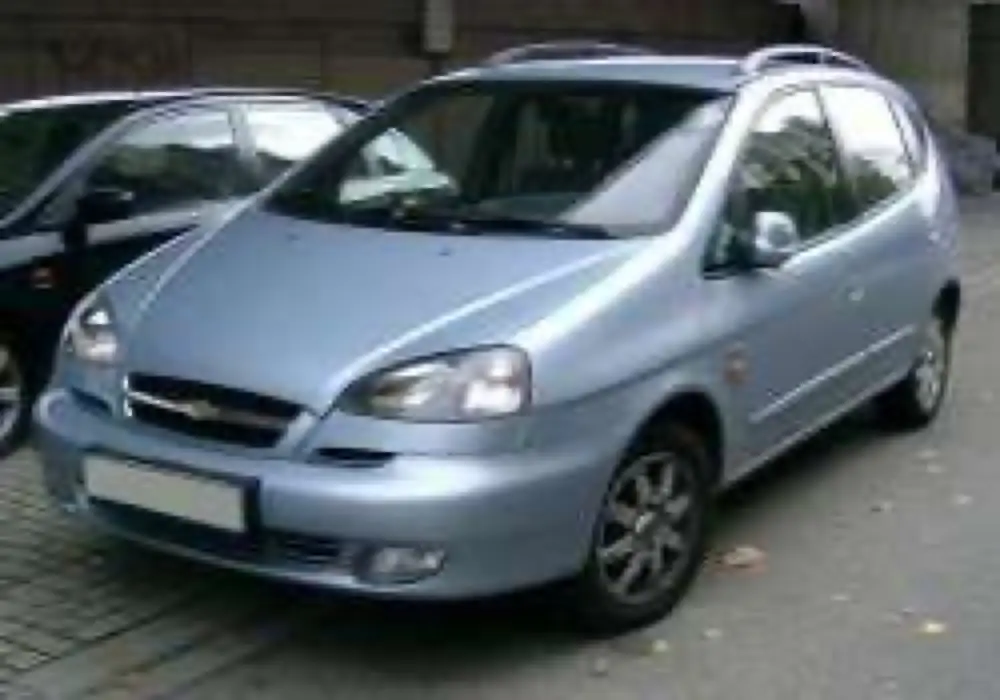
The Chevrolet Vivant is a compact MPV produced by South Korean manufacturer Daewoo since 2000. Developed under the U100 code name, it was designed by Pininfarina and is based on the original Daewoo Nubira J100, a compact car. Following the phasing out of Daewoo as a brand in most export markets, the car was rebadged as Chevrolet, retaining either model name depending on the market. Additionally, the Chevrolet Vivant nameplate was introduced for the South African and South American markets. The Vivant comes with 1.6 L Family 1 or 2.0 L Family II straight-4 engines. 1.8 L engine was offered until 2005. It is available with a five-speed manual transmission or a four-speed automatic. Standard Vivants have a seating capacity of five, but a seven-seater version was also introduced for the South Korean market. Maximum luggage capacity of the Vivant is 1425 L. In Korea, it is called Rezzo. It comes with 2.0 L Family II straight-4 engines and 2.0L E-TEC SOHC Liquefied petroleum gas (LPG) engines. Most Rezzo’s come fitted with an LPG powered engine because gasoline is very expensive in Korea.
Frequently Asked Questions
How to change the oil in a Chevrolet Vivant?
Changing the oil in a Chevrolet Vivant involves draining the old oil, replacing the oil filter, and refilling the engine with fresh oil. The oil filter is located on the bottom of the engine and can be accessed by removing the oil drain plug. It is recommended to use the manufacturer’s recommended oil type and viscosity for optimal engine performance.
How to replace the air filter in a Chevrolet Vivant?
Replacing the air filter in a Chevrolet Vivant involves locating the air filter housing, removing the old air filter, and installing a new air filter. It is recommended to replace the air filter every 12,000 to 15,000 miles for optimal engine performance and fuel efficiency.
How to replace the alternator in a Chevrolet Vivant?
Replacing the alternator in a Chevrolet Vivant involves disconnecting the negative battery cable, removing the serpentine belt, disconnecting the electrical connections to the alternator, and removing the mounting bolts. The new alternator is then installed and the serpentine belt is reinstalled. It is recommended to also test the battery and charging system for optimal performance.
How to replace the battery in a Chevrolet Vivant?
Replacing the battery in a Chevrolet Vivant involves disconnecting the negative and positive battery cables, removing the old battery, installing the new battery, and reconnecting the battery cables. It is recommended to also clean the battery terminals and cable ends with a wire brush and apply a small amount of dielectric grease for optimal battery performance.
How to replace the brake pads in a Chevrolet Vivant?
Replacing the brake pads in a Chevrolet Vivant involves removing the wheel, removing the brake caliper and old brake pads, installing new brake pads, and reassembling the brake caliper and wheel. It is recommended to also inspect the brake rotors for wear and replace them if necessary for optimal braking performance.
How to replace the fuel filter in a Chevrolet Vivant?
Replacing the fuel filter in a Chevrolet Vivant involves locating the fuel filter, disconnecting the fuel lines, and removing the old fuel filter. The new fuel filter is then installed and the fuel lines are reconnected. It is recommended to replace the fuel filter every 30,000 to 40,000 miles for optimal fuel system performance.
How to replace the power steering pump in a Chevrolet Vivant?
Replacing the power steering pump in a Chevrolet Vivant involves removing the serpentine belt, removing the old power steering pump, and installing the new power steering pump. It is recommended to also flush the power steering system and replace the power steering fluid for optimal power steering performance.
How to replace the radiator in a Chevrolet Vivant?
Replacing the radiator in a Chevrolet Vivant involves draining the cooling system, disconnecting the upper and lower radiator hoses, removing the radiator shroud and mounting bolts, and removing the old radiator. The new radiator is then installed and the cooling system is refilled with coolant. It is recommended to also replace the radiator hoses and thermostat for optimal cooling system performance.
How to replace the serpentine belt in a Chevrolet Vivant?
Replacing the serpentine belt in a Chevrolet Vivant involves locating the belt tensioner, releasing the tension on the belt, and removing the old belt. The new belt is then installed and the tension is adjusted to the manufacturer’s recommended tension. It is recommended to also inspect the other belt-driven components such as the alternator and water pump for wear and replace them if necessary.
How to replace the spark plugs in a Chevrolet Vivant?
Replacing the spark plugs in a Chevrolet Vivant involves removing the old spark plugs, installing new spark plugs, and reconnecting the ignition coils. It is recommended to use the manufacturer’s recommended spark plug type and gap for optimal engine performance.
How to replace the thermostat in a Chevrolet Vivant?
Replacing the thermostat in a Chevrolet Vivant involves draining the cooling system, removing the thermostat housing, removing the old thermostat, and installing the new thermostat. It is recommended to also replace the radiator hoses and flush the cooling system for optimal engine cooling performance.
How to replace the timing belt in a Chevrolet Vivant?
Replacing the timing belt in a Chevrolet Vivant involves removing the timing belt covers, aligning the timing marks, removing the old timing belt, and installing the new timing belt. It is recommended to also replace the water pump and timing belt tensioner for optimal engine performance.
How to replace the water pump in a Chevrolet Vivant?
Replacing the water pump in a Chevrolet Vivant involves draining the cooling system, removing the serpentine belt, removing the old water pump, and installing the new water pump. It is recommended to also replace the thermostat and flush the cooling system for optimal engine cooling performance.
How to replace the wheel bearings in a Chevrolet Vivant?
Replacing the wheel bearings in a Chevrolet Vivant involves removing the wheel, removing the brake caliper and rotor, removing the wheel hub assembly, and replacing the wheel bearings. It is recommended to also inspect and replace any worn suspension components for optimal handling and ride comfort.
What causes the check engine light to come on in a Chevrolet Vivant?
The check engine light in a Chevrolet Vivant can come on due to a variety of reasons such as a faulty oxygen sensor, a loose gas cap, a malfunctioning catalytic converter, or a failing ignition coil. It is recommended to have the vehicle’s diagnostic trouble codes read by a mechanic to determine the exact cause of the check engine light.
